
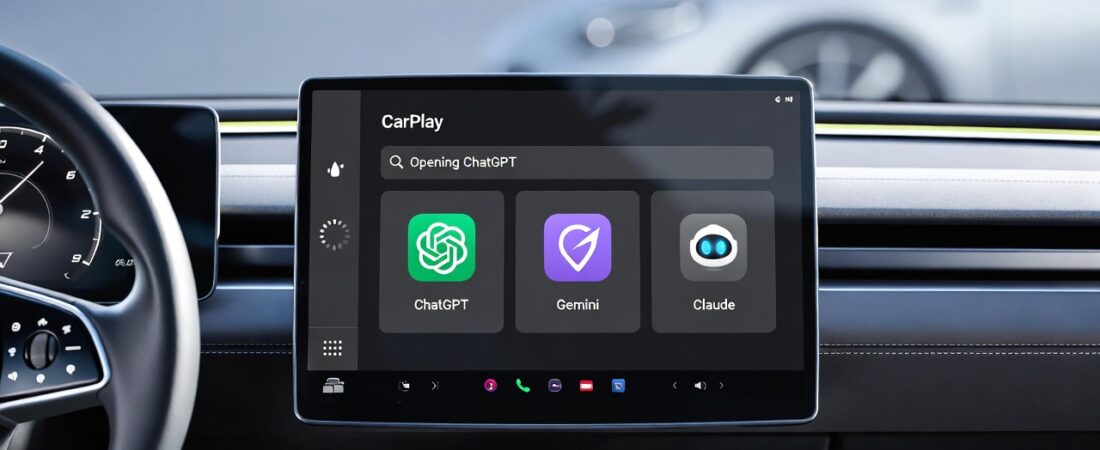
In a major shift for in-car software, Apple is reportedly opening CarPlay to third-party AI chatbots through upcoming iOS updates (expected around iOS 26.4). The move could allow drivers to interact with external AI assistants like those from OpenAI, Google, and Anthropic directly from their vehicle’s dashboard via voice.
This marks one of the biggest expansions of CarPlay’s capabilities since its launch, potentially transforming it from a navigation-and-media hub into a fully AI-powered driving companion.
What’s changing in CarPlay?
Until now, Apple has kept CarPlay tightly controlled. Siri handled most voice interactions, and third-party apps were limited to specific categories like navigation, messaging, and audio.
With the new update:
- CarPlay may support external AI voice assistants
- Drivers could choose their preferred chatbot
- AI interactions may work through Siri handoff or direct integration
- Developers may get new APIs for automotive AI experiences
Instead of only saying “Hey Siri,” drivers could ask questions, draft messages, summarize emails, or control smart-home devices using their preferred AI model.
Which AI chatbots could be supported?
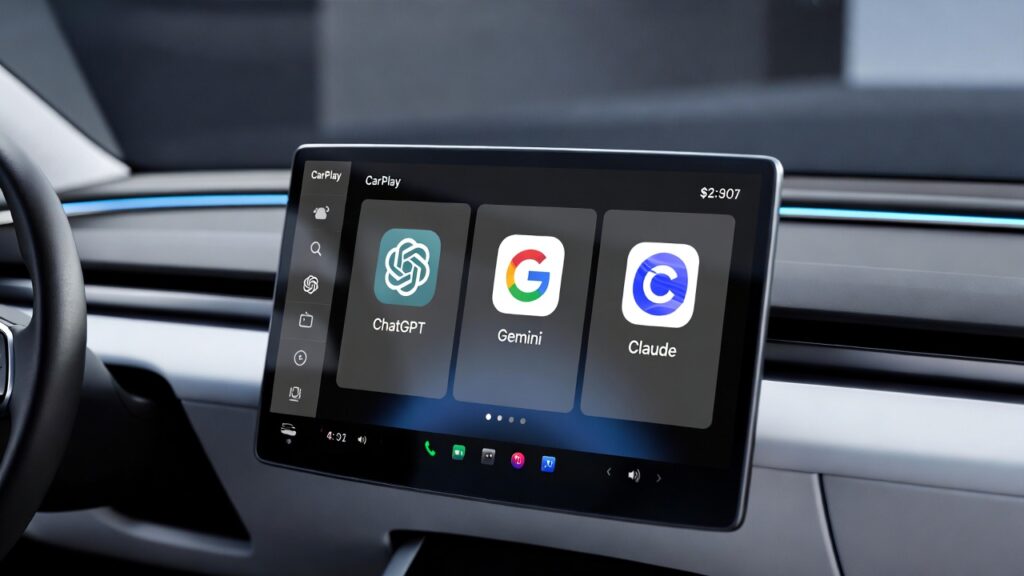
While Apple hasn’t officially confirmed a full list, early reports and developer hints suggest compatibility with:
- ChatGPT-based assistants
- Gemini-powered assistants
- Claude or other enterprise AI tools
- Future automotive-focused AI services
This aligns with Apple’s broader strategy of gradually opening its ecosystem to external AI while maintaining privacy controls.
Why Apple is doing this now
Several trends are pushing Apple toward this move:
1. Rising demand for AI in cars
Modern drivers want smarter assistants for navigation, productivity, and entertainment. AI can help with:
- Real-time travel planning
- Voice-controlled messaging
- Context-aware recommendations
- On-the-go information search
2. Competition in automotive software
Google’s Android Automotive and built-in AI systems from carmakers are advancing quickly. Opening CarPlay to third-party AI helps Apple stay competitive.
3. iPhone as the car’s brain
Apple still wants the iPhone to remain the central computing device in the car. Letting AI run through CarPlay keeps users inside the Apple ecosystem while expanding capabilities.
How it might work for users
Once the update rolls out, users could see:
- A default AI assistant selection in CarPlay settings
- Voice activation via steering-wheel button or wake phrase
- AI responses displayed safely on the dashboard
- Integration with Messages, Maps, and calendar
For example, a driver could say:
“Plan the fastest route home, summarize my unread emails, and send a reply that I’ll be late.”
The AI would handle all of it through voice, minimizing distractions.
Privacy and safety considerations
Apple is likely to keep strict rules around:
- Data sharing between AI providers and iOS
- On-device processing where possible
- Driver distraction limits
- App approval guidelines
Expect Apple to require AI responses to be voice-first and concise while driving.
What this means for developers
For app and AI developers, this could be huge:
- New CarPlay APIs for AI interaction
- Voice-first automotive apps
- Subscription-based in-car AI services
- Enterprise fleet integrations
If Apple opens this widely, CarPlay could become a major platform for AI distribution — similar to the App Store.
Potential timeline
- iOS 26.4 developer beta: expected to reveal APIs
- Public rollout: likely later in the year
- Car manufacturer support: gradual rollout via updates
As always, features may vary by region and vehicle model.
Final thoughts
Opening CarPlay to third-party AI chatbots could redefine the in-car experience. Instead of a simple interface for maps and music, your car could become an intelligent assistant that understands context, preferences, and daily routines.
If implemented well, this move could:
- Make driving more productive
- Reduce phone distraction
- Expand Apple’s AI ecosystem
- Give users freedom to choose their preferred assistant
The next version of CarPlay might not just connect your iPhone to your car — it could bring the full power of modern AI along for the ride.
Related posts:
 Apple’s iOS 26.4 Beta: What’s New and What to Expect
 Budget MacBook, Budget iPhone and More: What to Expect at Apple’s 4 March Event
 Best iPhone Hacks 2026 (iOS 26 Edition) 🔥📱
 iPhone 17e: A Masterstroke or Another Failure Like iPhone 16e?
 🍏 Apple’s March 2026 Launch: iPhone 17e, M4 iPad Air and M5 Macs Take Center Stage
 IPhone 17 Pro vs Galaxy S26 Ultra: Which Should You Buy in 2026?
 MacBook Neo Is Here: Apple’s Most Exciting Budget Laptop of 2026
 Honor Robot Phone vs iPhone 17 Pro: Innovation vs Perfection
 Meta–Nvidia AI Deal Explained (2026): Billions, Blackwell GPUs & Meta’s AI Future
 iPhone 17e: Apple’s Smartest Value Flagship of 2026