
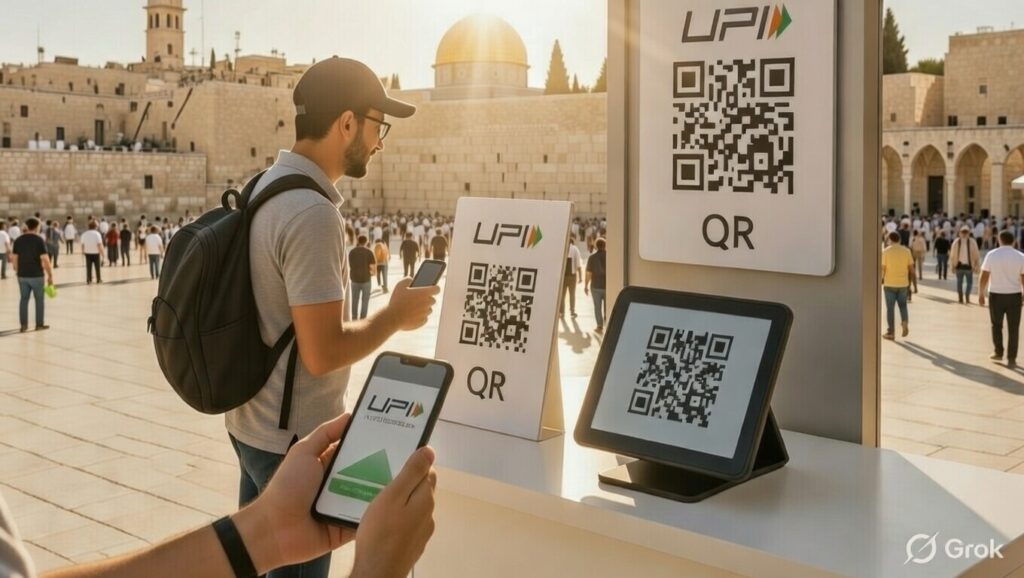
In early 2026, a landmark agreement was reached between India and Israel — one that promises to reshape how people and businesses transact across borders. The highlight? India’s Unified Payments Interface (UPI) — the digital payments backbone of India — is now set to be used in Israel, marking a major milestone in global fintech cooperation.
What Is UPI — A Quick Recap
Unified Payments Interface (UPI) is India’s real-time instant payments system developed by the National Payments Corporation of India (NPCI). It allows users to send and receive money directly from their bank accounts using a smartphone, without needing complex bank details. In India, UPI has been a revolutionary force — responsible for billions of transactions every month and forming the backbone of digital payments across the economy.
Internationally, it has already begun rolling out in multiple countries as part of a broader push to make UPI a global standard for digital payments.
Why UPI in Israel Is a Big Deal
🔹 1. Cross-Border Payments Made Easy
Traditionally, sending money between countries requires banks, foreign exchange fees, and slow settlement times.
With the UPI integration:
– Indian visitors and businesses in Israel can make seamless digital payments.
– Israeli businesses and tourists may soon interact directly with India’s digital payment ecosystem.
This move is expected to significantly reduce transaction costs and processing time, making cross-border commerce faster and cheaper than ever before.
🔹 2. Strengthening Trade and Travel
Linking UPI with Israel’s domestic payment systems means:
– Trade between India and Israel becomes smoother
– Indian tourists in Israel could potentially pay with UPI apps
– Israeli investors and entrepreneurs may enjoy easier financial access to Indian markets
This is especially important as more businesses operate internationally and people travel more frequently between countries.
🔹 3. Part of Broader Strategic Partnership
The UPI deal was announced during a high-profile state visit by Indian Prime Minister Narendra Modi to Israel where multiple memorandums of understanding were signed across technology, agriculture, digital health, and trade.
This signals that digital payments are no longer just financial tools but also instruments of economic diplomacy and technological cooperation.
What’s Next? The Path to Implementation
While the agreement has been signed, practical deployment will take some time. Earlier discussions between Indian and Israeli officials indicated that a joint system could be developed that allows real-time UPI-driven transactions with local currencies by the end of March 2026, subject to implementation timelines.
In other words:
– Indians could pay in Israeli shekels using UPI
– Israelis could transact in Indian rupees using linked systems
This bridges financial networks in a way similar to how UPI has already been extended to countries like UAE, Singapore, France, Nepal, and Bhutan.
Fintech in Israel — Before UPI
Israel already has a vibrant digital payments ecosystem. Apps like bit (dominant for peer-to-peer transfers) and PayBox offer instant transfers and QR payments to users and businesses.
However, these systems are largely domestic and do not natively support seamless cross-border transactions with foreign payment networks — a gap UPI now aims to fill.
The Future of UPI and Why It Matters
The expansion of UPI into Israel isn’t just about convenience — it illustrates a broader transformation:
– Digital payment systems are becoming globalized
– Countries are linking payment infrastructures to promote trade and tourism
– India’s UPI is positioned as a leading global solution
As UPI continues to expand internationally, it may set the stage for a new era of interoperable global payment networks — where money moves across borders as easily as a message on your phone.
In Summary
🌍 UPI’s entry into Israel marks a strategic advance in digital finance.
💸 It paves the way for faster, cheaper, seamless cross-border transactions.
🤝 It strengthens economic ties between India and Israel.
📱 And it illustrates how fintech innovations — once local — are now shaping global financial ecosystems.
UPI isn’t just a payment method — it’s a bridge across economies and cultures.
Related posts:
 India’s AI Boom: World’s Fastest-Growing AI Consumer — But Are We Building or Just Using?
 Sundar Pichai Meets Narendra Modi: What the February 18, 2026 Meeting Means for India’s AI and Tech Future
 Nvidia’s Big Bet on India: The $2 Billion AI Investment and What It Means
 Google Pixel 10a Launch in India: Expected Price, Specs, Features & Everything We Know
 Anthropic AI Shock: Why Indian IT Stocks Crashed
 Will Gold and Silver Surge as Iran–Israel Tensions Intensify?
 Best Phones Under ₹15,000 in India (February 2026) – Specific Picks & Comparison
 Best Laptops Under ₹60,000 for Coding (2026)
The Strait of Hormuz Crisis: How a Geopolitical Flashpoint Is Shaking Global Financial Markets
Best Laptops Under ₹60,000 for Coding (2026)
The Strait of Hormuz Crisis: How a Geopolitical Flashpoint Is Shaking Global Financial Markets
 🔥 Top 5 Phones Under ₹20,000 for Gaming in 2026