
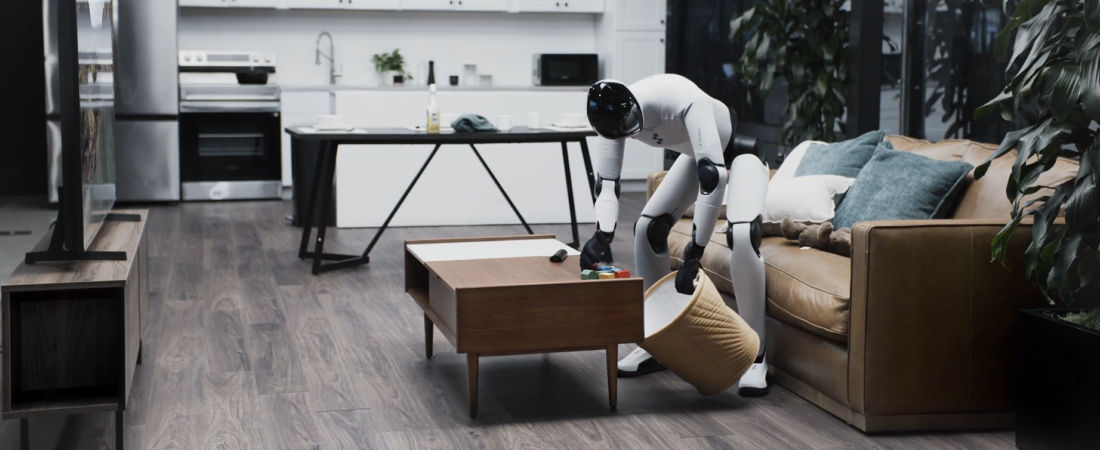
“A Robot That Can Clean Your House” might sound like science fiction, but it’s quickly becoming reality thanks to Figure AI and its advanced humanoid AI system Helix 02. This next-generation robotics technology is designed to power humanoid robots capable of cleaning living spaces, organizing objects, and completing complex household tasks autonomously.
Unlike traditional robots that rely on fixed programming, Helix 02 combines artificial intelligence, perception, and robotic movement into a single system. This allows robots to understand their surroundings, make decisions in real time, and perform multi-step tasks without human assistance. As AI continues to advance, the idea of leaving your home messy and returning to a perfectly tidy space may soon become a normal part of everyday life.
What Is Helix 02?
Helix 02 is an advanced AI control system developed by Figure AI to power humanoid robots capable of performing real-world tasks autonomously.
Instead of following simple scripts, Helix 02 uses neural-network-based AI models that allow robots to analyze their environment and react dynamically. This enables robots to:
- Recognize objects in real environments
- Understand spatial layouts in homes
- Plan actions and execute tasks
- Manipulate objects with precision
- Complete complex tasks independently
Essentially, Helix 02 acts as the brain of the humanoid robot, connecting sensors, reasoning, and movement into a unified system.
How This Robot Can Clean Your House
The goal behind Helix 02 is to create general-purpose humanoid robots capable of operating in everyday human environments.
Homes are complex environments filled with furniture, objects, and obstacles. Unlike industrial robots that operate in controlled environments, humanoid robots are designed to function in spaces made for humans.
With Helix 02, robots can potentially perform tasks like:
- Picking up items from the floor
- Organizing objects on tables
- Placing items back in cabinets
- Cleaning living rooms
- Loading or unloading dishwashers
In demonstrations, robots powered by Helix 02 have successfully completed full living-room cleanup tasks autonomously, showing how AI can coordinate perception, movement, and planning.
The AI Architecture Behind Helix 02
One of the most impressive aspects of Helix 02 is its multi-layer AI architecture, which allows robots to combine intelligence with physical movement.
Whole-Body Control
This system manages the robot’s balance and movement. It allows the robot to walk, bend, reach, and interact with objects naturally.
The robot constantly updates its movements thousands of times per second to maintain stability and precision.
Real-Time Sensor Processing
Helix-powered robots gather data from multiple sensors, including:
- Vision cameras
- Tactile sensors in fingertips
- Joint and motion sensors
These sensors help the robot detect objects and interact with them safely. For example, when picking up a fragile object, the robot can adjust its grip pressure to avoid breaking it.
AI Reasoning and Task Planning
The highest level of Helix 02 focuses on reasoning and planning.
When given a command such as:
“Clean the living room.”
The robot can break the task into multiple steps:
- Pick up objects from the floor
- Organize items on tables
- Place objects in their correct locations
- Reset the room layout
The robot then performs these tasks autonomously.
Advanced Dexterity and Object Handling
One of the biggest challenges in robotics is achieving human-level dexterity.
Helix 02 improves robotic dexterity using:
- Cameras embedded in the robot’s palms
- High-precision tactile sensors in the fingertips
This allows robots to perform delicate tasks such as:
- Picking up small objects
- Sorting cluttered items
- Opening containers
- Handling fragile household objects
These capabilities are essential for robots to function effectively in home environments.
Real-World Applications Beyond Home Cleaning
Although the concept of a robot that cleans your house is exciting, Helix-powered humanoid robots could have applications across many industries.
Home Assistance
Robots could help with everyday chores, assist elderly individuals, and support people with limited mobility.
Warehousing and Logistics
Humanoid robots could help organize inventory, sort packages, and assist workers in distribution centers.
Manufacturing
Factories could use humanoid robots to perform repetitive tasks while adapting to changing environments.
Healthcare
Robots may eventually support healthcare professionals by handling routine tasks, allowing doctors and nurses to focus on patient care.
Challenges Facing Household Robots
Despite major progress, several challenges remain before humanoid robots become common in homes.
These include:
- Safety and reliability
- Production costs
- AI adaptability
- Long-term autonomous operation
However, rapid advancements in robotics and artificial intelligence suggest these barriers may gradually decrease in the coming years.
The Future of Robots That Clean Your Home
The development of Helix 02 represents a major milestone in the evolution of robotics.
By combining AI reasoning, advanced sensors, and full-body robotic control, Figure AI is moving closer to creating practical humanoid robots capable of assisting humans in everyday environments.
In the near future, the idea of a robot that can clean your house, organize your belongings, and help with daily chores may become a normal part of modern living.
Conclusion
The Helix 02 system demonstrates how far humanoid robotics has progressed. With its ability to perceive environments, plan actions, and manipulate objects, it represents an important step toward practical household robots.
While widespread adoption may still take time, the rapid pace of innovation suggests that intelligent humanoid robots could soon become an integral part of homes, workplaces, and industries around the world.
Related posts:
 Honor Robot Phone vs iPhone 17 Pro: Innovation vs Perfection
 Honor Robot Phone: The Smartphone With a Gimbal 🤯
 WiFi That Can See Through Walls? Inside the WiFi-DensePose Technology
 Is This the Smartest Ring of 2026? Ultrahuman Ring PRO with Jade Explained
🍏 Apple’s March 2026 Launch: iPhone 17e, M4 iPad Air and M5 Macs Take Center Stage
Is This the Smartest Ring of 2026? Ultrahuman Ring PRO with Jade Explained
🍏 Apple’s March 2026 Launch: iPhone 17e, M4 iPad Air and M5 Macs Take Center Stage
 IPhone 17 Pro vs Galaxy S26 Ultra: Which Should You Buy in 2026?
 Meta–Nvidia AI Deal Explained (2026): Billions, Blackwell GPUs & Meta’s AI Future
 Google Pixel 10a Launch in India: Expected Price, Specs, Features & Everything We Know
 MacBook Neo Is Here: Apple’s Most Exciting Budget Laptop of 2026
Why Block’s Massive Layoffs Signal a White Collar Reset in 2026
MacBook Neo Is Here: Apple’s Most Exciting Budget Laptop of 2026
Why Block’s Massive Layoffs Signal a White Collar Reset in 2026