
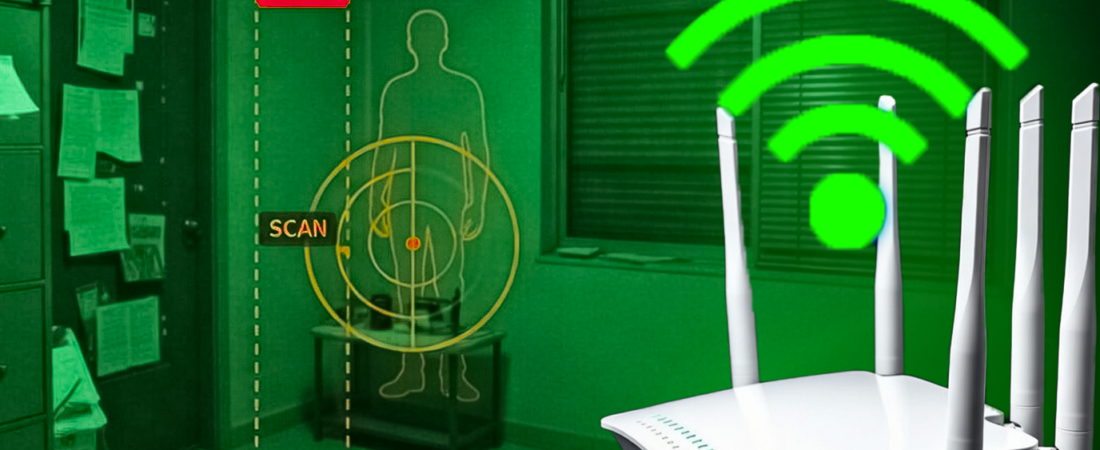
The idea that WiFi can see through walls might sound like science fiction, but emerging technologies like WiFi-DensePose are making it possible. WiFi That Can See Through Walls? Inside the WiFi-DensePose Technology explores how artificial intelligence can analyze wireless signals to detect human movement and estimate body positions—even when a person is behind a wall or in complete darkness. Instead of using cameras or wearable sensors, WiFi-DensePose studies how WiFi signals bounce off the human body and surrounding objects to understand motion and activity.
As research in wireless sensing advances, ordinary WiFi networks could eventually become powerful motion-tracking systems, capable of detecting movement inside homes, offices, hospitals, and public spaces.
What Is WiFi-DensePose?
WiFi-DensePose is a technology that uses WiFi signals combined with artificial intelligence to estimate human body poses. Traditional pose estimation systems rely on cameras and computer vision to track body joints like arms, legs, and shoulders.
WiFi-DensePose takes a different approach. Instead of analyzing images, it studies how WiFi signals change when they interact with the human body.
When wireless signals travel through a room, they reflect off walls, furniture, and people. The human body slightly alters these signals. By analyzing these changes using deep learning models, researchers can estimate where a person is and how their body is positioned.
The concept of DensePose refers to mapping detailed regions of the human body onto a digital model. Instead of identifying just a few joints, DensePose allows a much more detailed representation of body posture and movement.
How WiFi-DensePose Works
The system combines wireless signal processing and deep learning to interpret human movement.
1. WiFi Signal Transmission
A WiFi router constantly sends wireless signals throughout a room. These signals travel through walls, reflect off surfaces, and reach receiving devices such as laptops or antennas.
When a person moves within the environment, their body changes the signal path.
2. Signal Data Collection
The system captures detailed WiFi signal measurements known as Channel State Information (CSI).
CSI contains data about:
- Signal strength
- Signal phase
- Timing changes
- Distortion patterns
These variations contain hidden clues about movement inside the room.
3. AI-Based Pose Estimation
Machine learning models analyze these signal patterns to estimate human pose.
During training, researchers combine:
- WiFi signal data
- Camera-based pose labels
The AI learns how signal changes correspond to body positions. Once trained, the system can estimate poses using WiFi signals alone.
Can WiFi Really See Through Walls?
WiFi does not actually “see” like a camera. However, wireless signals can pass through walls and obstacles, which allows systems like WiFi-DensePose to detect signal changes caused by human movement even when the person is not directly visible.
This means the system can:
- detect motion behind walls
- track activity in darkness
- monitor movement without cameras
Because of this capability, the technology is often described as WiFi that can see through walls, although it is really detecting signal disturbances rather than creating images.
What WiFi-DensePose Can Be Used For
Smart Homes
Future smart homes could use WiFi sensing to detect human activity without cameras.
Possible applications include:
- automatic lighting adjustments
- intelligent climate control
- presence detection for home automation
Healthcare and Elderly Monitoring
WiFi-DensePose could help monitor movement patterns and detect falls in elderly individuals.
Potential uses include:
- fall detection systems
- activity monitoring
- movement analysis for rehabilitation
Because it does not require cameras, it could be more acceptable in private spaces.
Security and Intrusion Detection
Security systems could use WiFi sensing to detect movement even if cameras are blocked.
Applications may include:
- detecting intruders
- monitoring restricted areas
- improving smart alarm systems
Fitness and Exercise Tracking
The technology could analyze body movements during workouts.
Possible features include:
- posture detection
- exercise repetition counting
- movement analysis for training apps
Gaming and Virtual Reality
WiFi-based motion sensing could allow gesture-based interaction in games or virtual reality without requiring cameras or expensive sensors.
Advantages of WiFi-DensePose
Works in Darkness
Unlike cameras, WiFi signals are not affected by lighting conditions.
Works Through Obstacles
Wireless signals can travel through walls and furniture.
No Wearable Devices Needed
Users do not need to wear sensors or tracking devices.
Lower Hardware Cost
The technology can potentially work with existing WiFi infrastructure.
Limitations and Challenges
Accuracy Limitations
Environmental changes such as furniture movement can affect signal patterns.
Privacy Concerns
Although the system does not record images, some people worry about potential misuse for hidden surveillance.
Still Experimental
Most WiFi-DensePose systems are currently research prototypes rather than commercial products.
Try It Yourself: WiFi-DensePose Open-Source Code
Several developers and researchers have released open-source implementations of WiFi-based pose estimation systems. These allow developers to experiment with the technology and build their own applications.
Main repositories include:
WiFi-DensePose GitHub Repository
https://github.com/ruvnet/wifi-densepose
DensePose From WiFi Research Implementation
https://github.com/superstar1225/DensePose_from_WiFi
These projects demonstrate how WiFi signals combined with machine learning can estimate human movement and pose.
Some implementations include features such as:
- real-time pose estimation
- multiple person tracking
- motion detection through obstacles
- integration with AI frameworks
Because the code is open source, developers can modify it and build applications for smart homes, security systems, healthcare monitoring, or motion tracking.
How to Run WiFi-DensePose on Your Laptop
Developers interested in experimenting with WiFi-DensePose can run the open-source project locally.
Step 1: Install Python
Make sure Python 3.8 or later is installed on your system.
Step 2: Clone the Repository
Open a terminal and run:
git clone https://github.com/ruvnet/wifi-densepose.git
cd wifi-densepose
Step 3: Install Dependencies
Install the required packages using pip.
pip install -r requirements.txt
These dependencies usually include machine learning libraries such as:
- PyTorch
- NumPy
- OpenCV
Step 4: Connect WiFi Hardware
To capture signal data, you need a WiFi network interface card that supports CSI extraction.
Some experiments use specialized wireless adapters that allow low-level signal measurements.
Step 5: Run the Pose Detection System
Once everything is configured, the system can process WiFi signals and generate pose estimations using AI models.
Developers can then build applications such as:
- motion detection systems
- human activity recognition tools
- smart home automation systems
The Future of WiFi-Based Motion Tracking
WiFi-DensePose represents a fascinating shift in how wireless networks might be used in the future. Instead of simply providing internet connectivity, WiFi networks could become sensing platforms that understand human activity.
Researchers are exploring ways to combine wireless sensing with artificial intelligence to create smarter environments capable of detecting movement, presence, and behavior automatically.
If the technology continues to improve, future homes, hospitals, and workplaces may rely on WiFi not only for connectivity but also for intelligent sensing and interaction.
FAQ: WiFi-DensePose Technology
Can WiFi really see through walls?
WiFi signals can pass through walls, which allows systems like WiFi-DensePose to detect signal changes caused by human movement. However, it does not produce visual images like cameras.
Is WiFi-DensePose available for consumers?
Currently the technology is mostly used in research and experimental projects. It is not yet widely available in consumer devices.
Is WiFi-DensePose safe for privacy?
Because it does not record images, some researchers consider it more privacy-friendly than cameras. However, privacy concerns still exist depending on how the technology is used.
What hardware is required?
Typical setups include:
- WiFi routers or antennas
- network cards capable of CSI extraction
- machine learning frameworks such as PyTorch or TensorFlow
Related posts:
 Honor Robot Phone: The Smartphone With a Gimbal 🤯
 A Robot That Can Clean Your House: Figure AI Helix 02 Humanoid Robot Explained
 Honor Robot Phone vs iPhone 17 Pro: Innovation vs Perfection
 How Elon Musk Pushed Technology a Decade Ahead
 Why Block’s Massive Layoffs Signal a White Collar Reset in 2026
 Meta–Nvidia AI Deal Explained (2026): Billions, Blackwell GPUs & Meta’s AI Future
 Vivo V70 & Vivo V70 Elite: Everything You Need to Know
 Xiaomi 17 & Xiaomi 17 Ultra: What You Need to Know Before the Global Launch
Is This the Smartest Ring of 2026? Ultrahuman Ring PRO with Jade Explained
Nvidia Backs Wayve in $1.2 Billion AI Self-Driving Push
Xiaomi 17 & Xiaomi 17 Ultra: What You Need to Know Before the Global Launch
Is This the Smartest Ring of 2026? Ultrahuman Ring PRO with Jade Explained
Nvidia Backs Wayve in $1.2 Billion AI Self-Driving Push